


Water Is Getting Farther Away. Relay Pumping Is Now The Bottleneck.
Nov 13, 2026
Leave a message
The U.S. Department of the Interior's FY2027 request puts $3.96 billion into wildland fire service operations and $2.95 billion into the suppression reserve fund - $6.91 billion in total. Money at that scale buys aircraft, engines, and crews. It does not move a pond three kilometers closer to a burning slope.
That's the part procurement documents rarely spell out. In most of the terrain where fires actually run - ridgelines, cut blocks, scrub belts behind a village - the water source has moved. Longer dry spells, lower water tables, and smaller hold-over ponds mean crews are drafting from further out every season. The pump is no longer a piece of support equipment. It is the thing the whole hose lay depends on.
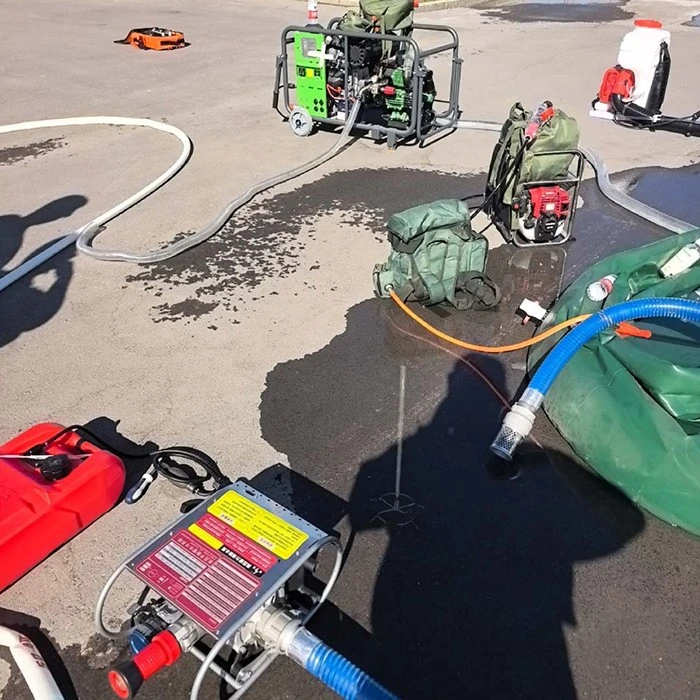
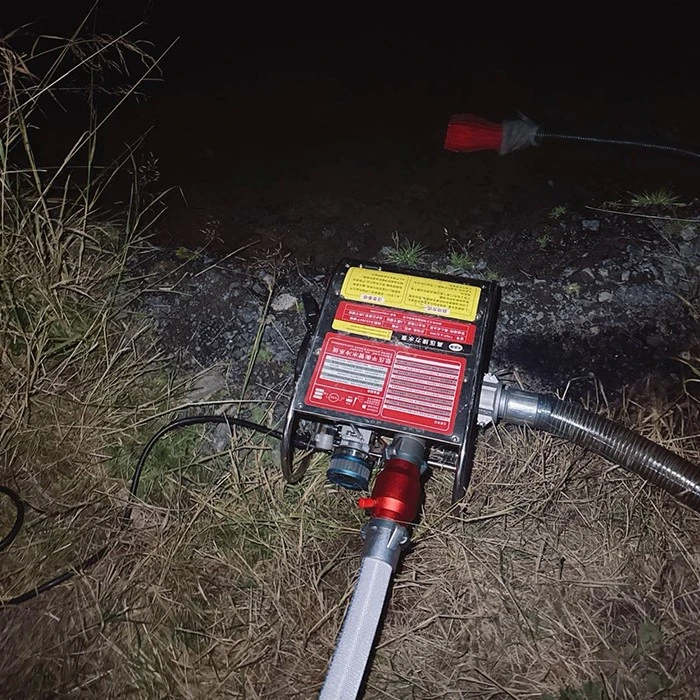
This portable forest firefighting pump is a two-stage centrifugal unit on a single-cylinder two-stroke engine. Pull the cord or hit the electric start and the impeller spins up to evacuate the chamber. Negative pressure does the rest - it pulls from a pond, a stream, or a bladder tank with no pre-filling. Priming takes under 16 seconds, cold start 8 seconds or less.
Two stages matter more than the spec sheet suggests. Water gets pressurized twice before it leaves the volute. The impeller eye stays under low pressure while the outlet holds high pressure, so once flow is established it holds. There are no seals to wear out and no priming pump to babysit mid-lay.
The output side is where the relay math gets decided: 233 m head, 2.30 MPa discharge, 310 L/min maximum flow, 34 m throw, 7 m suction lift with DN50 in and DN40 out. At 0.5 MPa the pump delivers 280 L/min. At 1.0 MPa it's 260, at 1.5 MPa it drops to 150, and at 2.0 MPa you still get 50 - enough to keep a nozzle working at the top of a slope. When one unit won't reach, units link in series or parallel.
Field weight is 12 kg net without electric start, on a 304 stainless backpack frame. Anti-reverse impeller, over-speed cutoff, and 48 hours of continuous running without drift. The kit ships complete: fuel tank, suction hose, priming pump, hose wrench, repair rings, two-stroke oil, foot-valve inlet hose, stop clamp, check valve, tee, adapters, straight and fog nozzles, tools, and starter battery.
表格
| Parameter | Specification |
|---|---|
| Pump type | Two-stage centrifugal, corrosion-treated aluminum |
| Engine | Single-cylinder two-stroke, mixed water/air cooling |
| Power / displacement | ≥ 10 HP at 12,000 rpm / ≥ 100 cc |
| Max head | 233 m |
| Max discharge pressure | 2.30 MPa |
| Max flow | 310 L/min |
| Throw / suction lift | 34 m / 7 m |
| Ports | DN50 in / DN40 out |
| Priming / cold start | < 16 s / ≤ 8 s |
| Fuel burn / tank | ≤ 3.5 L/h / 12 L |
| Net weight | 12 kg (without electric start) |
| Custom range | 0.7–6.0 MPa, 240–450 L/min |
"The budget conversation is about how many crews you can field," said a Linhao engineer on the pump line. "The hose lay conversation is about whether the first pump primes on the first pull. That one we can control."
Typical duty for this portable forest firefighting pump runs from initial attack and mop-up through flood control, drought relief, and dewatering on mining and construction sites. Configurations are built to order - start method, pressure band, flow band, impeller stages, and matched engine power.
About Zhenjiang Linhao Forest Fire Prevention Equipment Co., Ltd. Founded in 2010 in Zhenjiang, Jiangsu Province, Linhao has manufactured forest and grassland firefighting equipment for over 16 years, supplying forestry bureaus, fire brigades, and international wholesale clients. OEM/ODM and custom builds available.
CTA Ask for the pressure-flow curve and a quotation - sales@lhfirefighting.com
Send Inquiry